Tesla vs. Waymo: The Sensor Bet That Decides Driverless Reliability
Tesla relies on cameras and AI. Waymo combines cameras, lidar, and radar. The deeper difference is how each company approaches the final, expensive climb toward driverless reliability.
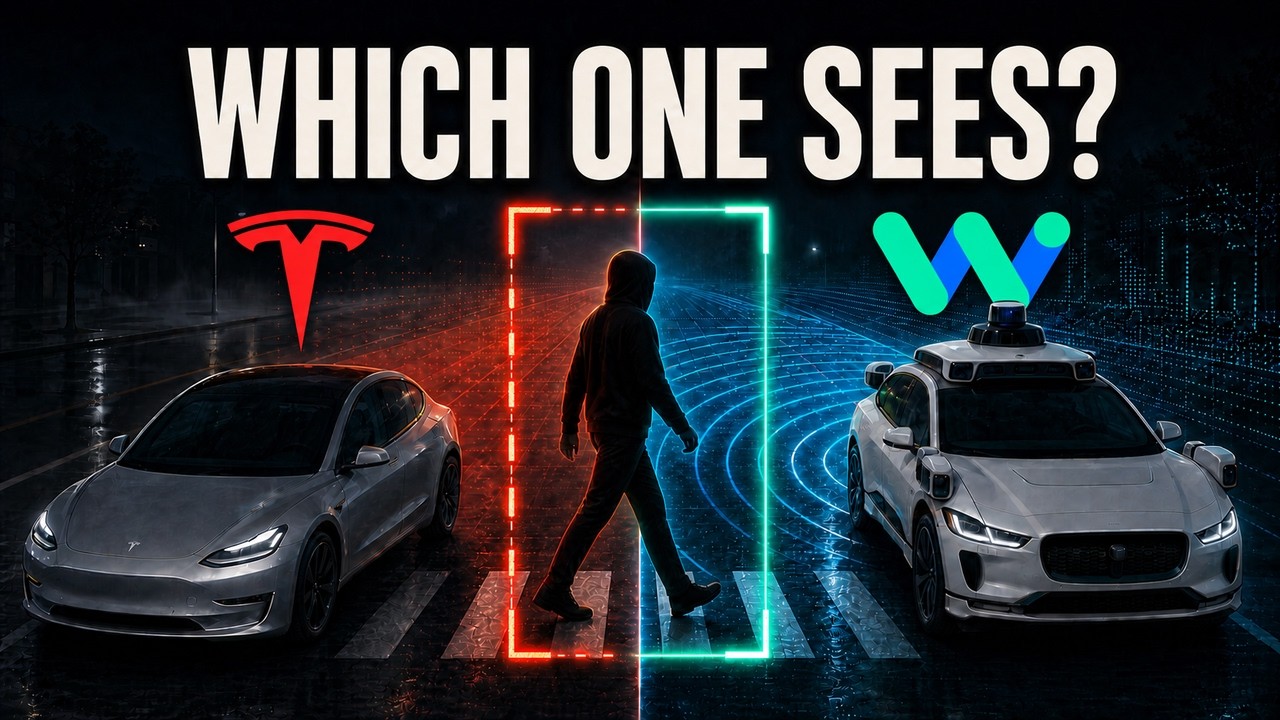
Tesla and Waymo want the same future: cars that can drive without human intervention. But they made sharply different bets about what a vehicle must sense when no human is available to rescue it.
Tesla built its approach around cameras and AI. Waymo also uses cameras, but adds lidar and radar to provide overlapping measurements of depth, range, and motion. That extra hardware can look expensive or redundant—until visibility degrades, an unusual hazard appears, or the system must make a decision without human backup.
The important question is not simply which system looks more elegant. It is which technical path can reach the reliability threshold required by the actual product.
The visible difference: inference versus measurement
Tesla's consumer vehicles primarily use cameras to perceive the world. Neural networks interpret the video stream, identify objects, estimate depth and motion, and choose a driving action. Tesla's own documentation says Full Self-Driving (Supervised) uses cameras around the vehicle to build a model of its surroundings.
Waymo combines several sensing modalities:
- Cameras capture color, texture, signs, signals, and fine visual detail.
- Lidar directly measures three-dimensional structure and distance.
- Radar provides another measurement of range and motion.
These sensors are not perfect. Cameras can struggle with darkness, glare, rain, or an obstructed lens. Lidar and radar have limitations too, while adding cost, calibration, compute, and maintenance. The engineering case for multiple modalities is not that one sensor never fails. It is that different sensors can fail differently.
When the main input becomes weak, independent measurements may reduce how much the system must infer.
The products are not yet equivalent
A fair comparison must begin with what each company is actually proving.
Tesla's widely available Full Self-Driving product remains supervised. Tesla requires the driver to remain attentive and ready to take over. That human is part of the safety system.
Waymo operates rider-only service in defined geographic areas. There is no human driver inside the vehicle waiting to correct the next mistake. Its operating domain is constrained, but within that domain the system carries the full driving responsibility.
This distinction matters because supervised assistance and rider-only autonomy demand different levels of reliability. A system that works impressively with a human fallback may still be far from a product that must handle every relevant situation alone.
Why 99% can still be nowhere near finished
Waymo co-CEO Dmitri Dolgov describes autonomy as an exponential ladder of nines.
Moving from 90% reliability to 99% removes nine out of every ten remaining failures. Moving from 99% to 99.9% does it again. The arithmetic is simple, but the engineering is not. The failures left at each stage tend to be rarer, stranger, and less likely to share a common cause.
This is why “99% accurate” can be misleading. Suppose a system fails once in every 100 relevant interactions. At small scale, that may look excellent. Across millions of interactions in public, it becomes an enormous operational problem—especially when a failure can injure someone and cannot be undone.
Risk ≈ failure probability × exposure × consequence
This is not a complete safety equation. It is a reminder that average success cannot be judged separately from scale and stakes.
A working demo may be only 1% of the work
Dolgov has said Waymo's early autonomous-driving demonstration took roughly 18 months, while the journey to a scaled product took about 15 years. His broader lesson was that a convincing demo may represent only a tiny fraction of the work required for a dependable physical-world product.
The gap includes far more than sensors. It includes simulation, mapping, validation, software, fleet operations, hardware reliability, service design, incident response, and the careful definition of where the system can operate.
That creates a common technology trap. One approach may improve quickly at first, producing the best demo, then flatten below the threshold the product must cross. Another may climb more slowly but eventually pass the required line.
If we judge only by early progress, we may choose the wrong curve.
What the public evidence says today
The strongest public evidence currently favors Waymo for driverless operation—but the conclusion needs boundaries.
Waymo reports 220.6 million rider-only miles through March 2026. Its company analysis also reports 94% fewer serious-injury-or-worse crashes than an adjusted human benchmark across the surface streets included in its operating cities.
Those numbers are meaningful because they come from substantial real-world operation without a human driver. They are not a universal verdict on every road or weather condition. Waymo explicitly notes that autonomous and human crash data are not perfectly comparable. Reporting rules, road mix, operating domains, benchmark construction, and underreporting all affect the comparison.
Tesla publishes safety data for Full Self-Driving (Supervised), but those results should not be placed directly beside Waymo's rider-only figures as though the products and definitions were identical. Tesla's consumer system still includes a human fallback, and the companies use different collision categories, exposure conditions, and benchmarks.
Waymo currently has stronger public evidence for rider-only driving. That does not prove cameras can never reach the same threshold, or that sensors alone explain Waymo's lead.
Waymo's results come from an entire system. Tesla's large consumer fleet may generate valuable training data and could support faster scaling if its architecture reaches the required reliability. The long-term outcome remains an engineering question, not a matter of brand loyalty.
Four questions for evaluating any AI demo
The Tesla–Waymo debate offers a framework that applies well beyond autonomous cars.
- How reliable must the real product be?
Do not evaluate a system against the requirements of a demonstration. Evaluate it against the conditions in which people will actually use it. - What does one failure cost—and can a human undo it?
An incorrect email draft can be reviewed. A vehicle mistake may unfold before anyone can intervene. Higher consequences demand stronger evidence. - When the main input becomes weak, can the system obtain useful information another way?
Redundancy is not automatically good, but complementary information becomes more valuable as the cost of uncertainty rises. - What kind of evidence are you seeing?
Separate a curated demo from a realistic evaluation, and both from unsupervised real-world deployment. Each supports a different claim.
The lesson beyond self-driving cars
The same pattern appears in AI agents that can spend money, robots working beside people, medical systems influencing treatment, and cybersecurity tools protecting production infrastructure.
Early capability is visible and exciting. Reliability work is slow and mostly invisible. But the final product is defined by what happens in the tail: the rare conditions, weak signals, strange combinations, and failures that emerge only at scale.
The best technology curve is not necessarily the one that rises fastest. It is the one that reaches the line that matters.
Sources and further reading
- Watch the companion video
- Dmitri Dolgov: The Demo Is Only 1% of the Work
- Waymo Safety Impact
- Waymo's sixth-generation Driver
- Tesla Full Self-Driving (Supervised) documentation
- Tesla Full Self-Driving safety report
- Original Electrek report
Safety figures are time-bounded and reflect company-published data available in August 2026. They should be interpreted with the methodologies and limitations provided by each source.
Comments
Post a Comment